Dead Water Rising: How to Spot, Diagnose, and Revive a Forgotten Fishing Hole
There's a certain kind of angler who slows down when they drive past a beat-up drainage ditch, a cattle-trampled streambank, or a pond that hasn't seen a fishing rod in a decade. Most people keep driving. That angler pulls over.
If that sounds like you — or like the person you want to become — you're already halfway to something real. Because across the US, there are tens of thousands of waterways that got written off. Farmers diverted them. Developers channelized them. Suburban runoff choked them out. And then everyone just... stopped going. The fish didn't always leave forever. Sometimes they just need a reason to come back.
This is about giving them one.
Why Anglers Abandon Water (And Why That's Actually Good News)
When a fishing spot gets a bad reputation, it empties out fast. Word spreads that the bass have gone soft, the trout disappeared, or the water turned green every August. People migrate to the next hotspot, and the overlooked stretch gets left to its own devices.
Here's the thing: abandonment creates opportunity. When the pressure drops, even marginal habitat can start to recover on its own — slowly, quietly, and usually without anyone noticing. A few fish hold on. Aquatic insects start reclaiming cleaner riffles. Beaver activity reshapes a bend. Nature doesn't give up as fast as people do.
The angler who shows up to a neglected spot with curious eyes instead of low expectations is going to see things others missed. That's not optimism — it's a diagnostic skill worth developing.
Step One: Figure Out Why the Water Died
Before you do anything else, you need to understand what knocked the fishery down. There's no single answer, and getting this wrong wastes time. Here are the most common culprits in US freshwater systems:
Siltation and bank erosion. Unshaded banks, cattle access, and upstream development all funnel sediment into waterways. That sediment buries gravel beds where fish spawn and smothers the invertebrate communities that feed them. If you're wading through ankle-deep muck where there used to be rock and gravel, this is your problem.
Invasive species pressure. Hydrilla, purple loosestrife, Asian carp, snakehead — the list of invasives degrading US fisheries is long and regional. In some spots, invasive vegetation has so thoroughly choked the shallows that juvenile fish can't move, feed, or survive to maturity. In others, invasive predators have collapsed native prey populations.
Nutrient overload. Agricultural runoff loaded with nitrogen and phosphorus turns water into soup. Algae blooms crash dissolved oxygen levels, especially at night and in summer. Fish kills follow. If a waterway smells wrong and looks green, you're dealing with eutrophication.
Thermal stress. Losing streamside trees means losing shade. Losing shade means warmer water. Warmer water holds less oxygen and pushes cold-water species — trout, especially — into smaller and smaller refuges until there's nowhere left to go.
Hydrological alteration. Ditching, channelization, and dam removal (or dam presence) all reshape how water moves through a system. A straightened creek moves too fast, cuts too deep, and loses the slow pools and complex structure that fish depend on.
You can usually diagnose two or three of these just by walking the water for an hour with your eyes open. Bring a notebook.
What One Person Can Actually Do
Let's be honest about scale. You're not going to dredge a river or reroute agricultural drainage by yourself on a Saturday. But that's not the point. Small-scale, consistent intervention — the kind any motivated angler can pull off — genuinely moves the needle over time.
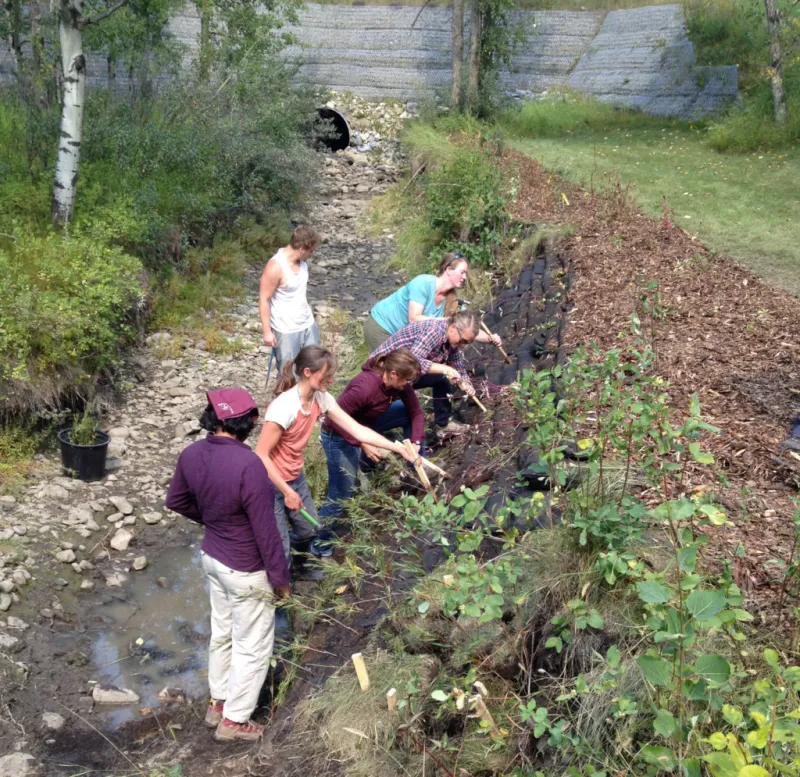
Plant the banks. Bare streambanks are a cascade problem. Get native plants in the ground — willows, sedges, native grasses — and you start slowing erosion, cooling the water, and building the overhanging vegetation that drops insects into the current. Many state conservation agencies and programs like the USDA's EQIP offer free native plant stock for riparian restoration. You don't always have to pay for it.
Pull invasives. Early-season manual removal of invasive vegetation before it sets seed is one of the highest-impact things a single person can do. It's hard, wet, unglamorous work. It also actually works, especially on smaller water bodies where the infestation hasn't gone systemic yet.
Add structure. Woody debris — fallen logs, root wads, brush bundles — creates holding lies, shades the substrate, and slows current enough to let silt drop out in strategic places. If a stream has been stripped of natural wood, adding it back (with landowner permission) can change the character of a run surprisingly fast.
Monitor and document. Buy a basic water quality test kit. Track temperature, dissolved oxygen, and pH across seasons. Map where you find fish, where you don't, and what changes year to year. You're building a dataset that tells a story — one you can eventually share with a local watershed council, a state fisheries biologist, or a conservation organization if you want to escalate your efforts.
The Mindset Shift That Makes This Possible
Most of us were taught to find fish where fish already are. Go to the productive spots. Follow the reports. Chase the hatch. That's fine fishing advice, and it'll put fish on the end of your line.
But there's a different mode available — one where you're not just reading water, you're reading potential. Where a silted-up pool isn't a dead end, it's a restoration project. Where a stretch of river that hasn't been stocked in years is either a blank canvas or a recovering wild system, and your job is to figure out which.
Anglers who operate this way tend to build something rare: a personal relationship with a specific piece of water over years and decades. They watch it change. They contribute to those changes. They catch fish that nobody else even knew were there.
That's not just satisfying — it's a form of conservation that doesn't require a 501(c)(3), a committee meeting, or a grant cycle. It requires showing up, paying attention, and doing the small things that compound over time.
Starting Points Worth Knowing
If you want to dig deeper into diagnosing and working on local water, a few resources are worth bookmarking:
- Your state's department of natural resources or fish and wildlife agency often has watershed assessment data, habitat priority maps, and staff biologists who are genuinely happy to hear from engaged citizens.
- The USGS StreamStats tool lets you pull hydrological data on almost any waterway in the country — useful for understanding flow history and catchment characteristics.
- Trout Unlimited's local chapters run stream habitat projects across the country and often welcome volunteers who just want to learn and work, no prior experience required.
- Your county extension office can connect you with native plant programs, soil and water conservation districts, and landowner outreach if you need to navigate access questions.
The Fish Are Waiting
Somewhere within a reasonable drive of where you're sitting right now, there's a piece of water that used to hold fish and doesn't anymore — or holds far fewer than it should. It's probably not on anyone's hot list. The parking spot is overgrown. The access trail is faint.
Go look at it. Walk the banks. Ask why. Come back with a shovel and some native plants, or just a pair of waders and a trash bag. Start a log.
The quiet rebellion isn't loud. It doesn't trend. But it catches fish — and it builds something worth protecting.