Why You Can't Stop Going Back: The Neuroscience of the Strike and What It Means for How You Fish
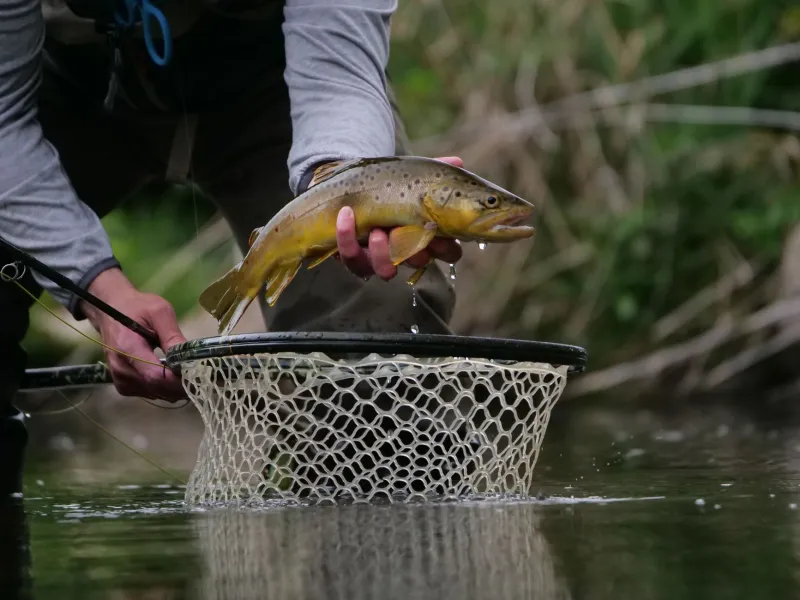
You've told yourself you'd sleep in. You meant it. And then 4:47 a.m. rolls around and you're already loading the truck, thermos in hand, headed back to that same bend in the river where a brown trout made you look foolish three weekends running. Logic says stay home. Something older than logic says go.
That pull isn't weakness. It's neuroscience — and it's worth understanding, especially if you care about the fish and the water on the other end of the line.
The Dopamine Isn't Where You Think It Is
Most people assume the reward in fishing is the catch. Land a fish, feel great. Simple enough. But behavioral researchers have been quietly dismantling that idea for years.
Dr. Wolfram Schultz, a neuroscientist whose work on reward prediction has been widely cited in behavioral psychology, found that dopamine — the brain's primary "reward" chemical — doesn't spike at the moment of reward. It spikes in anticipation of it. The real neurochemical high happens the moment you think something good might happen.
For anglers, that translates to one specific moment: the twitch of the line. The tap. The subtle drag that makes your whole body go still. That half-second before you know whether it's a fish or a stick — that's when your brain lights up like a pinball machine. The actual landing? That's almost anticlimactic by comparison.
This is why catch-and-release fishing is so psychologically potent. You're not farming fish. You're chasing a sensation your brain is literally wired to pursue — and because the outcome is genuinely uncertain, the reward system never gets bored. Unpredictability is the engine of habit.
The Habit Loop, Explained Streamside
Charles Duhigg, author of The Power of Habit, broke down behavioral loops into three components: cue, routine, and reward. Fishing maps onto this framework almost perfectly.
The cue is environmental and deeply personal. It might be the smell of river water, the sound of a reel clicking, the sight of rising fish at dusk, or even just loading your truck with waders. These sensory triggers fire before conscious thought kicks in. Veteran anglers often describe feeling calm the moment they step out of the car at the water — that's the cue already doing its work.
The routine is the cast itself. The retrieve. The read of the water. The physical choreography of fishing is repetitive by design, and repetition deepens neural pathways. The more you do it, the more automatic — and the more necessary — it starts to feel.
The reward is that dopamine hit of anticipation, the chaos of a fighting fish, and the satisfaction of a clean release. But here's the kicker: because the reward is intermittent — you don't get a strike every cast — the loop actually strengthens rather than weakens over time. Psychologists call this a "variable ratio reinforcement schedule," and it's the same mechanism behind slot machines. The unpredictability doesn't discourage you. It hooks you deeper.
Real Anglers, Real Patterns
Talk to serious catch-and-release fishermen long enough and a pattern emerges. It's not really about the fish.
Mike Trevino, a fly fisher out of Colorado who's been working the South Platte for over fifteen years, put it plainly: "I've released thousands of trout. I couldn't tell you what most of them looked like. But I can tell you exactly what the water sounded like on a Tuesday morning in October when a 20-inch rainbow took a size 18 RS2. That moment — that's what I'm chasing."
That kind of memory consolidation is itself a neurological process. Emotionally charged experiences — especially those involving surprise and physical engagement — are encoded more deeply in the brain's hippocampus. You don't just remember great fishing moments. You relive them, which makes you want to recreate them, which sends you back to the same stretch of water, again and again.
For some anglers, this loop becomes compulsive. Hours get lost. Relationships get strained. The water starts to feel less like a place and more like a need. That's worth paying attention to.
Fishing With Intention Instead of Compulsion
Understanding the neuroscience doesn't mean you have to stop loving it. It means you can choose it more clearly.
Behavioral psychologists who work with outdoor athletes often talk about the difference between reactive habits and intentional rituals. A reactive habit is one you fall into because your brain is chasing a chemical reward. An intentional ritual is one you design — same behavior, but anchored to a purpose beyond the dopamine hit.
For anglers who care about conservation, that reframe matters. When you go back to the same water not just because your brain is craving the strike, but because you're invested in the health of that fishery — you start to notice different things. You track water temperature. You observe whether the hatches are thinning. You pick up trash on the bank without thinking about it. The habit loop is still running, but it's pointed somewhere bigger than the next bite.
That's the version of the fishing habit worth building.
The Fighting Line as Feedback
There's one more layer to this worth sitting with. The fighting fish — that taut, electric connection through the rod — is a two-way communication. You're reading the fish, and in a real sense, you're reading the water it came from.
A healthy fishery produces strong, wild fish that fight hard. When that fight starts to feel different — shorter, softer, less frequent — that's data. Your nervous system notices before your conscious mind catches up. Anglers who have spent years on the same water often describe a gut feeling when something's off, long before they can articulate what it is.
That intuition is built from thousands of reps in the habit loop. It's one of the most valuable things a repeat angler develops — and it's only available to people who keep showing up.
Go Back. But Know Why You're Going.
The pull back to the water is real, it's biological, and there's nothing wrong with it. Your brain is doing exactly what brains do — seeking patterns, chasing rewards, building grooves in the neural landscape that feel like home.
But the anglers who get the most out of this sport — and who give the most back to it — are the ones who eventually ask themselves a harder question than where should I fish? They ask: what am I actually here for?
The answer, if you sit with it long enough, is usually bigger than a fish on the end of a line. It's the water. The silence. The thing that was there before you arrived and will be there after you leave — if you take care of it.
Gear up. Cast out. Protect what you love. And next time you feel that line go tight, pay attention to what happens in your chest before your hands even move. That's the whole story, right there.